Family-honor code
The House of Bernarda AlbaThe Family-honor code in The House of Bernarda Alba turns reputation into a form of household discipline: sexual behavior is judged publicly, women bear the burden of preserving the family name, and scandal is treated as a threat to be concealed or punished. Its force is clearest in the contrast between the villagers’ pursuit of an unmarried mother and Bernarda’s insistence that Adela’s death be publicly presented as a virgin’s death.
Reputation as Social Discipline
The play’s commentary connects sexual conduct to the family’s name and standing. In the traditional social order it describes, what mattered was not only what a person had done but how others perceived it. Sexual transgression could become village gossip and damage a whole household’s reputation. Bernarda consequently monitors her daughters’ behavior and speech, anxious that their actions or arguments might be overheard and discussed beyond the house.
The code is gendered. Women’s sexuality is sharply condemned, while men’s sexual freedom is treated with greater tolerance and even regarded as a sign of masculinity. The resulting double standard denies the possibility of sexual equality: a woman’s perceived misconduct can become a public disgrace, while comparable behavior by men is more readily accepted. Poncia shares aspects of this outlook, including her concern that the household remain respectable, showing that the rule extends beyond Bernarda’s personal authority.
Public Shame and the Unmarried Mother
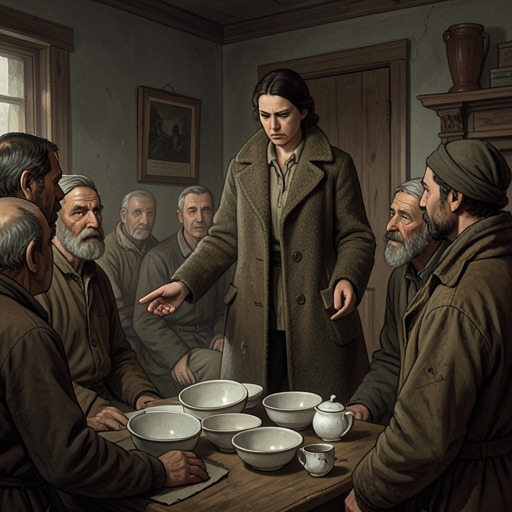
The code’s punitive force becomes visible when Poncia reports the fate of Librada’s daughter, an unmarried woman who has killed her child and concealed the body. After dogs uncover it, villagers pursue her, and men rush from the paths and olive groves. Bernarda endorses the crowd’s demand that she be killed and calls for people to join it with olive switches and pick-handles. Adela objects, pleading that the woman not be killed; Martirio, by contrast, supports going out with the pursuers.
The episode shows reputation operating not as a matter of private disapproval but as a license for collective punishment. The unmarried mother is treated as a target of violence, and Bernarda’s response aligns household authority with the village’s punitive judgment. Adela’s protest makes the conflict within the rule explicit: she refuses to accept the crowd’s demand for the woman’s death, even as the rest of the scene reveals how readily shame becomes violence.
The Household’s Secrets and the Final Cover-Up
The play also links honor to inheritance and concealed family relationships. Angustias receives substantially more from her stepfather’s will than his four natural daughters. The commentary raises, without resolving, the possibility that Antonio María Benavides favored her because of a closer relationship and asks whether Bernarda suspected it. The question remains one of the household’s hidden uncertainties, rather than an established explanation for the inheritance.
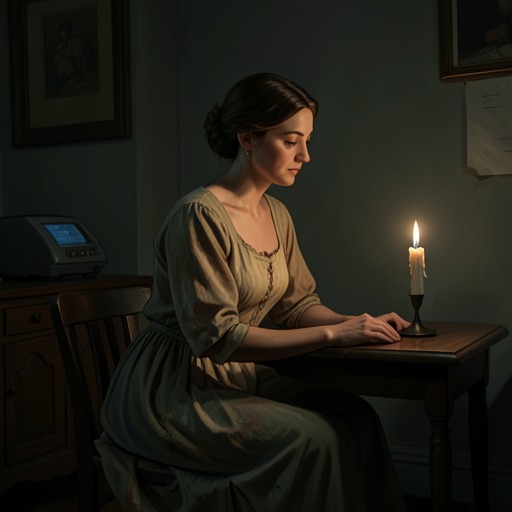
At the climax, Bernarda’s response to Adela’s death gives the rule its most decisive expression. After a shot is heard and Martirio first claims that Pepe el Romano is dead, Adela runs into another room and locks the door. When the door is opened, Poncia’s words and gesture make clear that Adela has hanged herself. Bernarda orders her body cut down and directs the household to announce that Adela died a virgin. Her declaration suppresses the truth of Adela’s relationship with Pepe el Romano in order to protect the family’s public standing; she then forbids the other women to weep openly and commands silence.
Social and Legal Context
The commentary places this code against a history in which honor could be connected to violence as well as gossip. It notes that Spain’s Penal Code of 1870 permitted a husband to claim he was cleansing his honor with blood in specified circumstances involving adultery or rape, and that this provision was not repealed until 1963. The play does not depict that precise legal situation, and Bernarda’s actions should not be mistaken for a direct enactment of the statute. Rather, the comparison illuminates the broader mentality in which family reputation could be treated as justification for severe responses to women’s sexuality.
The play presents that mentality as part of provincial social life, not as Bernarda’s isolated invention. In a tightly knit community, gossip, criticism, and concern over family names shape conduct inside and outside the household. The ending brings those pressures together: even after Adela’s death, Bernarda’s priority is to control what the community will hear. The command to preserve the family’s appearance becomes the final action of the rule.